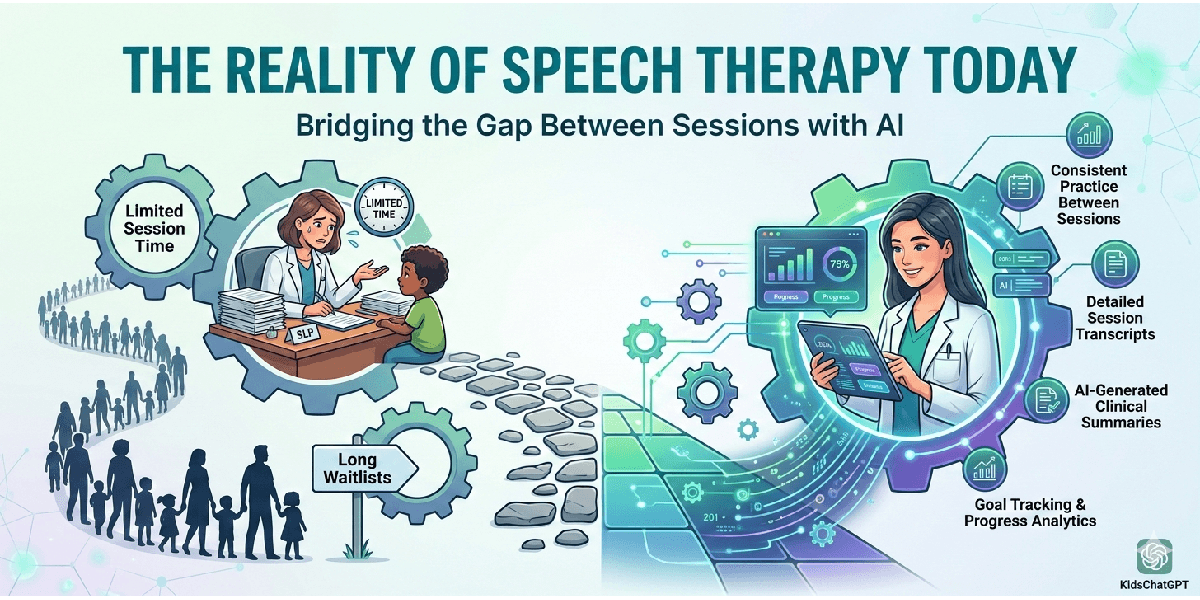
The Reality of Speech Therapy Today
Speech-language pathologists (SLPs) face real constraints: limited session time, long waitlists, and gaps between appointments. A child might practice for 30 minutes a week with a therapist and need reinforcement the other six days.
That's where AI can help—not by replacing the therapist, but by bridging the gap between sessions.
What KidsChatGPT's Therapist Plan Offers
1. Consistent Practice Between Sessions
Patients can chat with AI between therapy appointments to:
- Practice articulation in natural conversation
- Work on pragmatic language goals (turn-taking, topic maintenance)
- Build confidence in a low-pressure environment
- Continue learning vocabulary or syntax concepts
With encrypted conversation logs, you see exactly what they practiced.
2. Detailed Session Transcripts
Every conversation is encrypted and stored. You can:
- Review transcripts to identify patterns and progress
- Spot areas where the patient struggles consistently
- See their communication in natural (not just clinical) contexts
- Generate AI-powered summaries highlighting progress toward goals
3. AI-Generated Clinical Summaries
The Therapist Plan creates automatic summaries that highlight:
- Communication patterns observed in sessions
- Progress toward specific therapy goals
- Recommendations for focus areas
- Notable improvements or concerns
This cuts down paperwork and lets you focus on clinical decision-making.
4. Goal Tracking & Progress Analytics
Set therapy goals for each patient. The system:
- Tracks goal mentions across conversations
- Calculates progress percentage based on session transcripts
- Shows trends over weeks/months
- Alerts you to patients who need attention or are achieving milestones
Perfect for progress notes and family conferences.
5. Customizable Therapy Prompts
Each patient can have custom instructions. Examples:
- For articulation: "Encourage the patient to speak slowly and clearly. Gently model correct pronunciation without being judgmental."
- For pragmatics: "Practice turn-taking. Ask open-ended questions and give the patient time to respond. Notice when they change topics abruptly."
- For fluency: "Use pacing cues. Provide calm, unhurried conversation. Don't pressure fast speech."
- For voice: "Monitor vocal quality. Suggest breaks if the patient sounds strained."
Real-World Use Cases
Case 1: Speech Delay
Patient: 6-year-old with significant expressive language delay.
Therapist approach: Set goals around sentence length and vocabulary expansion. Patient chats 2-3x per week between sessions. AI responds with expansions ("You said 'dog run'—yes, the dog is running fast!"). Therapist reviews transcripts weekly.
Outcome: Increased practice frequency. Patient sees progress in real conversations (not just drills). Family more engaged because they see specific examples of growth.
Case 2: Articulation Disorder
Patient: 8-year-old with /r/ sound substitution (/w/ for /r/).
Therapist approach: Custom prompt asks AI to model correct /r/ sounds and gently encourage repetition. Goal set: "Produce /r/ sound accurately in conversation 80% of the time." Patient practices during leisure time.
Outcome: More naturalistic practice than drills. AI doesn't judge. Patient is more willing to try. Transcripts show measurable progress.
Case 3: Stuttering / Fluency
Patient: 10-year-old with mild persistent stuttering, high anxiety about speaking.
Therapist approach: Custom prompt prioritizes low-pressure conversation and pacing cues. Goal: "Speak with patient in relaxed, unhurried manner." Monitor vocal patterns in transcripts.
Outcome: Patient builds confidence in a judgment-free space. Anxiety decreases. Therapist has concrete data on fluency patterns across contexts (not just the clinic room).
HIPAA-Compliant & Encrypted
All patient data is encrypted end-to-end (AES-256-GCM). Conversation logs and memories are encrypted before storage. Only the therapist can decrypt. This meets HIPAA requirements for speech therapy contexts.
Device Management & Patient Safety
Therapists can:
- Register trusted devices (parent's phone, family tablet)
- Use PIN-based access (simple 4-digit code)
- Revoke devices if a patient should no longer have access
- End sessions remotely if needed
Patients can't accidentally share access with peers or unsupervised contexts.
Integration with Clinical Workflow
The Therapist Plan ($79/month) fits naturally into speech therapy:
- Pre-session: Review transcripts and summaries from past week
- During session: Use insights to tailor treatment focus
- Post-session: Set new goals, adjust custom prompts
- Documentation: AI-generated summaries speed up progress notes
- Family communication: Share specific examples from transcripts to show progress
What It's NOT
Important clarifications:
- Not replacing therapist judgment: AI gives you more data, not recommendations. You decide treatment.
- Not a substitute for clinical sessions: In-person or telehealth therapy is still essential.
- Not taking over treatment: You control the prompts, goals, and direction.
- Not magic: Some patients will make great progress; others will need more intensive support. AI surfaces patterns, but you diagnose.
Ready to Upgrade?
The Therapist Plan starts at $79/month and includes unlimited patients, encrypted transcripts, AI summaries, goal tracking, and device management. Designed by clinicians, for clinicians.