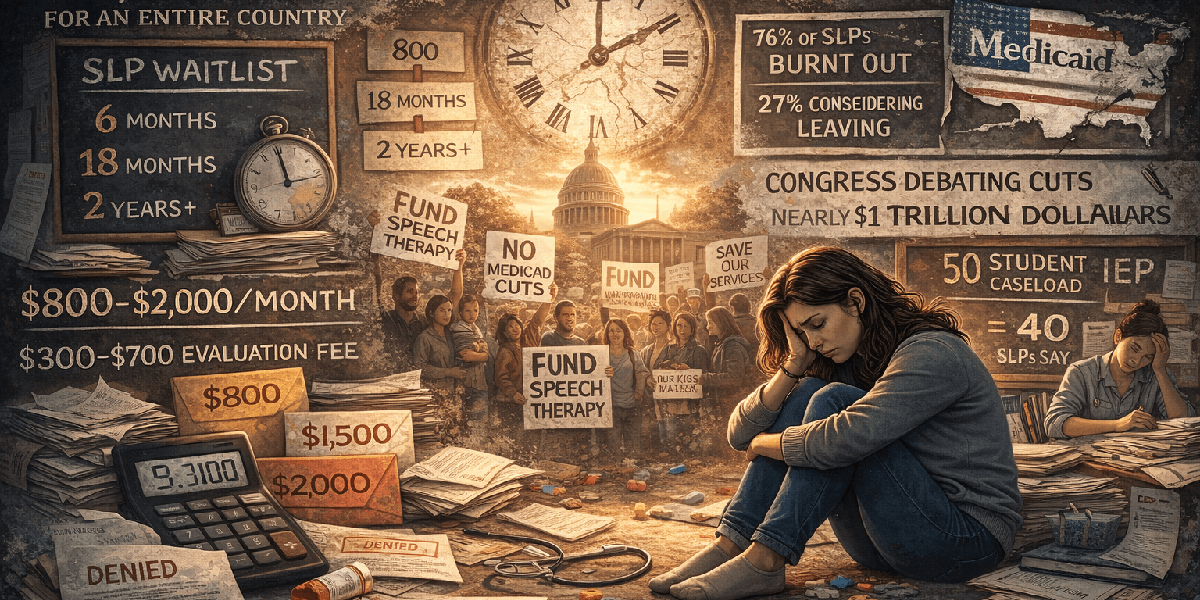
The U.S. has roughly 187,400 speech-language pathologists for an entire country. Waitlists run anywhere from six months to three and a half years.
One parent described it this way: “When you hear the word autism, you're introduced to the fact there's a 12 to 18-month wait. So that's 12 to 18 months wasted. Then OT took us two years to get in, speech took us six months.”
When you do finally get in, private speech therapy costs $100 to $250 per session. If your child needs two sessions a week — which is the bare minimum most therapists recommend — you're looking at $800 to $2,000 every single month.
That's before insurance denials. Before the appeals process. Before the $300–$700 evaluation fee just to get started.
And in 2026? It's getting worse.
Congress is currently debating cuts that would gut Medicaid by nearly $1 trillion. In Idaho, the governor proposed eliminating Medicaid coverage for speech therapy entirely — capping visits at just 20 per year.
Over 500 families showed up at the statehouse to fight it.
Families like Julie McConnel’s, whose twin sons Charlie and Milo both have Down syndrome and both depend on speech therapy to communicate and thrive.
Those families won — for now. But the pressure is everywhere.
The SLPs themselves? 76% are reporting burnout. 27% are considering leaving the profession entirely.
School-based SLPs carry an average caseload of 50 students — that's 50 children, each with their own IEP, their own goals, their own needs.
And the median manageable caseload SLPs say they can actually serve well is 40.
Do the math.
Your child is getting the best their SLP can give inside a system that is stretched past its limits.