The Landscape of AI Apps for Kids
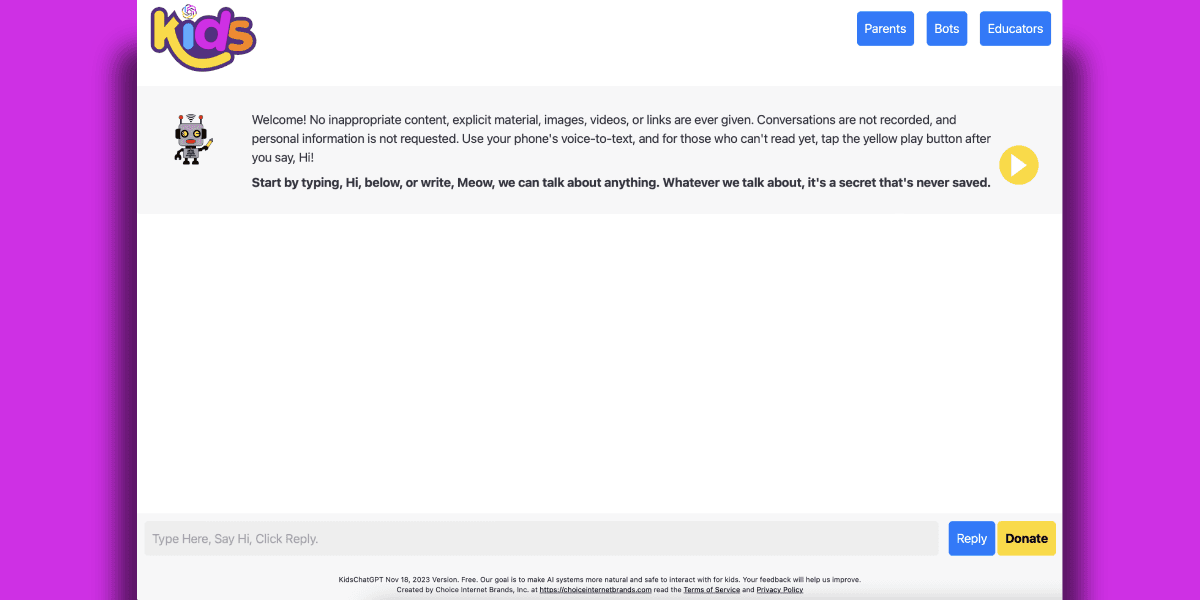
The market for children's AI companions and educational chatbots has exploded in recent years. But not all apps prioritize child safety and healthy engagement. Let's be transparent about how KidsChatGPT stands out.
Red Flags to Watch In Other Apps
1. No Parental Controls or Transparency
The Problem: Many mainstream AI apps (like some Discord bots, Character.ai, or ChatGPT plugins) offer zero parental visibility. You don't know what your child is talking about with an AI.
KidsChatGPT: Parent Plan includes full conversation access and AI summaries. You can see everything (with your child's knowledge).
2. Attention Hijacking Features
The Problem: Apps use streaks, daily challenges, notifications, and gamification to create addictive habits. Research shows kids who see these features spend significantly more time than they intend.
KidsChatGPT: No streaks. No daily challenges. No push notifications trying to pull you back in. Conversations simply end when you close the app.
3. Unclear or Invasive Data Practices
The Problem: Many apps collect conversation data for model training or ad targeting. Your child's conversations become part of training datasets—and you don't know it.
KidsChatGPT: COPPA-compliant (Children's Online Privacy Protection). We don't train on your data. Parent Plan conversations are encrypted. No data sharing with third parties.
4. Inadequate Content Filtering
The Problem: Some apps have weak content filters that require constant parental intervention. Others are so strict they're not helpful for learning.
KidsChatGPT: Proprietary filtering combined with age-appropriate system prompts. Bad words are blocked. Inappropriate topics are redirected. But the AI isn't neutered—kids still learn.
5. No Usage Limits or Screen Time Tools
The Problem: Apps designed to maximize engagement have no built-in way to set healthy boundaries.
KidsChatGPT: You can monitor session frequency and duration. Parent Plan shows analytics to help you understand patterns and set informed limits together with your child.
Where KidsChatGPT Actually Differs
Our Commitment to Ethical Design
We believe kids deserve AI tools that are:
- Transparent: You know what your child is doing (if you're paying to monitor)
- Non-manipulative: No dark patterns. Engagement based on actual interest, not tricks
- Bounded: Clearly defined use cases (learning, emotional support, homework) not infinite scrolling
- Age-appropriate: Responses calibrated to developmental stage
- Privacy-first: Encrypted conversations. COPPA-compliant. Your data is yours
Quick Comparison Table
| Feature | KidsChatGPT | Typical Competitor |
|---|---|---|
| Parental Access | ✓ Full transcripts | ✗ None or minimal |
| Addiction Features (streaks, notifications) | ✗ None | ✓ Multiple |
| COPPA Compliance | ✓ Yes | ✗ Unclear |
| Data Encryption | ✓ AES-256 | ✗ Often not |
| Content Filtering | ✓ Proprietary + prompt-based | ✓ Usually basic |
Real Talk: We're Not Perfect
No app is perfect. KidsChatGPT is still AI—it can make mistakes, hallucinate, or miss context. That's exactly why parental involvement matters. The goal isn't to replace you; it's to give you tools to stay informed and support your child's learning.
Why Transparency Matters
The 2025 regulatory landscape is shifting toward stronger children's privacy protections. Connecticut, Montana, and Nebraska have already banned dark patterns. Vermont requires dark pattern regulations by January 2027. At KidsChatGPT, we're not waiting for regulation—we're building the standard we want to see.
Your child deserves AI tools designed with their wellbeing in mind, not their engagement metrics. That's our promise.