The Speech Therapy Crisis No One Is Talking About
More than 3.4 million American children struggle with speech and language challenges. Demand for speech-language pathologists is projected to grow 19% through 2032, but the supply of qualified professionals cannot keep pace. Waitlists stretch months long. Sessions cost $100–$250 per hour. Many school districts share a single SLP across multiple buildings.
For parents watching their child struggle to communicate, the wait feels impossible. That is why a new wave of AI-powered speech therapy apps has arrived, promising to supplement professional care and give kids extra practice between sessions. But do any of them actually work?
We reviewed every major AI speech therapy app and tool available for children in 2026. This is not a list of paid endorsements. We built KidsChatGPT as a child-safe AI platform with HIPAA-compliant therapist tools, so we understand both the technology and the clinical requirements from the inside. Here is what we found.
What AI Can and Cannot Do for Speech Therapy
Before diving into specific apps, parents need to understand what current AI technology is actually capable of when it comes to children’s speech.
A landmark 2025 study from Stanford University tested 15 large language models, including multiple versions of GPT-4, Whisper, Gemini, and Qwen, on their ability to assess children’s speech patterns. The results were sobering: none came close to the 80–85% accuracy threshold that the FDA recommends before deploying a tool in clinical settings.
The models were better at diagnosing speech issues in boys than in girls, in English speakers than in speakers of other languages, and in older children compared with younger ones. When researchers fine-tuned open-source models specifically for the task, accuracy improved significantly, but gaps remained.
What does this mean for parents? AI speech therapy apps can be genuinely useful for:
- Structured practice between sessions — Repetition is critical for speech improvement, and apps provide endless patient practice partners
- Engagement and motivation — Gamified exercises keep kids practicing longer than traditional worksheets
- Progress tracking — Digital tools can log practice frequency and duration, giving therapists useful data
- Accessibility — Children in rural areas or on long waitlists can start practicing immediately
However, AI is not ready to replace a licensed speech-language pathologist. As Lauren Arner of the American Speech-Language-Hearing Association stated: “While generative AI can be a powerful tool, it’s absolutely not a substitute for the knowledge and expertise of a speech-language pathologist.”
With that context, here are the apps worth considering.
Best AI-Powered Speech Therapy Apps for Kids
1. Articulation Station Pro — Best for Articulation Practice
Price: $59.99 one-time purchase
Ages: 4+
Platform: iOS
Articulation Station remains the gold standard for speech sound practice, and for good reason. Developed by a team of speech-language pathologists and parents, it targets 22 English consonant phonemes through six different activity types: flashcards, matching games, sentence completion, unique words, rotating sentences, and stories.
With over 1,200 real photo flashcards, children can practice sounds at the word, phrase, sentence, and story levels. The app includes built-in data tracking so parents and therapists can monitor progress over time.
What we like: Evidence-based methodology, comprehensive phoneme coverage, no subscription required. Nearly every SLP we researched listed this as their top recommendation.
Limitations: iOS only. No AI-powered speech recognition, so it relies on a parent or therapist to judge accuracy. The interface feels dated compared to newer apps.
2. Speech Blubs — Best for Toddlers and Early Intervention
Price: $59.99/year subscription
Ages: 1–8
Platform: iOS, Android
Speech Blubs uses a video-modeling approach where children watch other kids demonstrating sounds and words, then try to imitate them. The app incorporates AI-powered speech recognition to provide feedback on pronunciation attempts.
With over 1,500 exercises covering early sounds, words, sentences, and conversation skills, it is one of the most comprehensive options for very young children. It supports kids with autism spectrum disorder, Down syndrome, apraxia, and general speech delays.
What we like: The peer-modeling approach (watching other children speak) is backed by research and uniquely motivating for toddlers. Cross-platform availability. The breadth of content is impressive.
Limitations: The AI speech recognition for very young children is imperfect. Some parents report the voice detection triggers too easily or misses correct attempts. The subscription model adds up over time. Privacy policy could be more transparent about data handling.
3. Sara Speech — Best New AI-Powered Option
Price: Free during early access
Ages: 4–12
Platform: iOS, Web
Born out of Columbia University, Sara Speech won first place at the 2025 Startup Columbia entrepreneurship challenge. The app guides kids through audio-based activities designed with direct input from speech pathologists and uses AI that operates at the phoneme level rather than just the word level.
This distinction matters. Most speech recognition technology works on a word level, but Sara Speech’s model attempts advanced sound and phoneme-level recognition. This means it can detect specific errors like difficulty with the /r/ sound and provide targeted feedback.
What we like: Phoneme-level AI analysis is a genuine technical advancement. Developed in collaboration with SLPs. Free during the early access period.
Limitations: Still in early access, so the content library is limited. Long-term pricing is unknown. Being new means less clinical validation than established tools. Not yet available on Android.
4. SpeechLP — Best for Gamified Articulation
Price: Free during launch phase
Ages: 3–10
Platform: iOS
SpeechLP officially launched at the ASHA 2025 Conference, combining advanced phonetic-level analysis with gamified practice. The app targets articulation skills through interactive games that feel more like play than therapy, while giving SLPs and parents actionable insights into a child’s progress.
What we like: Launched at the premier speech pathology conference with professional buy-in. The gamification approach keeps kids engaged. Phonetic-level analysis, not just word-level.
Limitations: Apple-only at launch. Very new, so limited user reviews and long-term outcome data. The free launch pricing will eventually change.
5. Otsimo — Best for Autism and Developmental Delays
Price: Free with premium subscription available
Ages: 2–10
Platform: iOS, Android
Otsimo was designed specifically for children with autism and developmental delays. It combines AI-powered speech recognition with engaging game mechanics across both speech therapy and broader educational activities. Internal data suggests children using Otsimo show 50% higher engagement rates and 30% faster skill acquisition compared to traditional methods alone.
What we like: Purpose-built for children with special needs, not retrofitted. Cross-platform. The combination of speech therapy with broader developmental activities makes it useful beyond just speech practice. Strong engagement metrics.
Limitations: The “50% higher engagement” and “30% faster acquisition” claims are from internal data, not independent peer-reviewed research. The free version is limited, and the premium subscription cost can add up.
6. Huni — Best for Targeted Word Practice
Price: Free with in-app purchases
Ages: 2–8
Platform: iOS, Android
Huni takes a focused approach: the app prompts a list of words to say, children listen to correct pronunciations, then repeat them one by one while the AI speech recognition evaluates their attempts. It was designed for children with delayed speech, non-verbal children, and kids with developmental disorders including apraxia and stuttering.
What we like: Simple, focused design that does one thing well. Cross-platform. Good for quick, structured practice sessions. Low barrier to entry with the free version.
Limitations: Limited scope compared to more comprehensive apps. The word lists can feel repetitive. Less engaging for children who need gamification to stay motivated.
7. ImagiRation Speech Therapy — Best Clinical Evidence
Price: Varies by module ($2.99–$9.99 per step)
Ages: 2–10
Platform: iOS, Android
ImagiRation stands apart with a 3-year clinical study involving 6,454 children with autism. The study found that children who engaged with the app’s exercises showed 2.2 times greater language improvement than children with similar initial evaluations who did not use it. The app uses a proprietary AI algorithm to measure similarity between model words and children’s vocalizations.
What we like: The strongest clinical evidence of any app on this list. A 3-year study with over 6,000 children is significant. The step-by-step progression (Steps 1–5) provides a structured curriculum.
Limitations: The modular pricing means the full suite costs more than it first appears. The interface is more clinical than playful, which may affect engagement for some children.
Best Tools for Speech-Language Pathologists
KidsChatGPT Therapist Sessions — Best HIPAA-Compliant AI Platform for SLPs
Price: Subscription-based
Platform: Web (works on any device)
Full disclosure: this is our platform. We built KidsChatGPT’s therapist session system specifically to address a gap we saw in the market: there was no HIPAA-compliant AI chat tool designed for speech-language pathologists to use with their patients.
Here is what makes it different from the consumer apps listed above:
- HIPAA-compliant encryption: All conversation logs and extracted patient memories are encrypted with AES-256-GCM before database storage. This is not optional or an add-on. Every piece of patient data is encrypted at rest.
- Therapist-controlled environment: SLPs create patient profiles, set custom therapeutic prompts, and control all aspects of the session. The AI does not operate unsupervised.
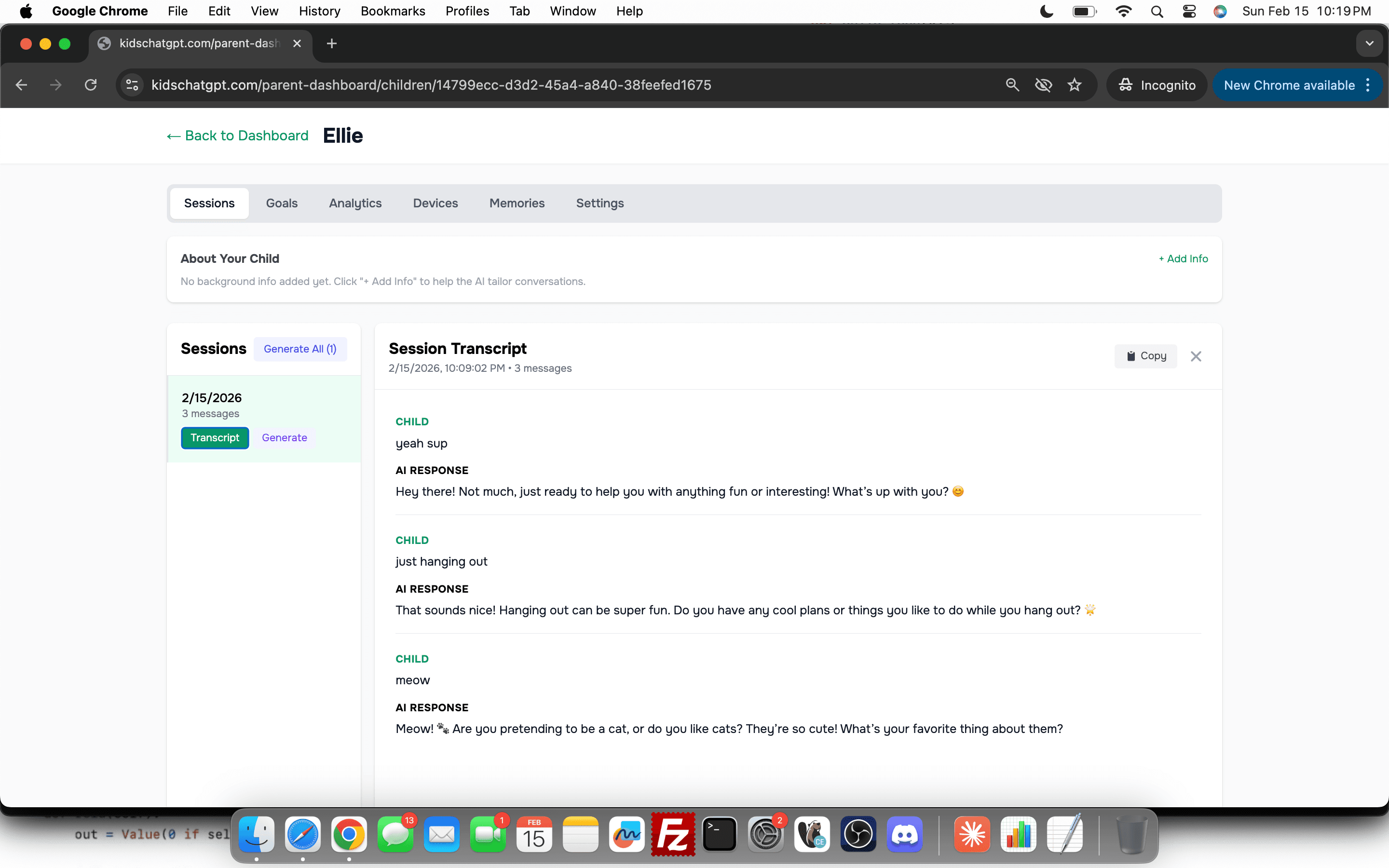
- Long-term memory extraction: The system automatically extracts and stores relevant memories from each session (preferences, facts, achievements, therapy-relevant details) and injects them into future sessions. This means the AI remembers that a patient loves dinosaurs, struggled with /s/ blends last week, or just started a new school.
- Session summaries: AI-generated clinical summaries tailored for speech-language pathology, covering communication patterns, therapy goal progress, and clinical recommendations.
- Goal tracking: Set patient goals and let the AI analyze session transcripts to calculate progress, track mentions, and identify trends over time.
- Device-based patient authentication: Patients authenticate via PIN on trusted devices. No patient accounts or passwords needed. Therapists can revoke device access at any time.
- Analytics: Per-patient and practice-wide analytics including session frequency, message counts, duration trends, and weekly reports.
This is not an app parents download for their kids to use alone. It is a professional clinical tool that enables SLPs to extend their practice with AI while maintaining full control and regulatory compliance.
Other SLP-Focused AI Tools
Several other AI tools are gaining traction among speech-language pathologists for practice management and session preparation:
- Ambiki: AI-powered session planning that factors in client goals and interests to suggest activities
- Kiki Creates: AI tool tailored specifically for SLPs, OTs, and PTs to generate therapy materials
- Speechzella: AI assistant designed to help SLPs with documentation and planning
- ChatGPT / Claude: General-purpose AI that many SLPs use for generating word lists, activity ideas, and therapy materials (but not HIPAA-compliant for patient data)
The critical distinction with general-purpose AI tools: popular options like ChatGPT are not HIPAA-compliant. OpenAI does not enter into Business Associate Agreements with covered entities. If you are entering identifiable patient information into ChatGPT, you may be violating HIPAA regulations. Always use tools specifically designed for clinical use when handling patient data.
How to Choose the Right App for Your Child
With so many options, here is a practical framework for making the right choice:
Consider Your Child’s Specific Needs
- Articulation (trouble with specific sounds): Articulation Station Pro or SpeechLP
- Early language development (late talker, limited vocabulary): Speech Blubs or Huni
- Autism or developmental delays: Otsimo or ImagiRation
- General speech practice between SLP sessions: Sara Speech or Speech Blubs
- Professional SLP looking for a clinical tool: KidsChatGPT Therapist Sessions
Questions to Ask Before Downloading
- Was it developed with SLP involvement? Apps created by or with speech-language pathologists are more likely to use evidence-based methods.
- What does the AI actually do? Some apps use AI for speech recognition and feedback. Others just use it as a marketing buzzword for basic audio playback. Ask specifically what the AI component does.
- How is your data handled? Check the privacy policy. Does the app record your child’s voice? Where is that data stored? Is it used to train AI models? For therapy-related apps, is it HIPAA-compliant?
- Is there clinical evidence? Look for apps that cite peer-reviewed research, not just testimonials or internal data.
- Does it complement your SLP’s approach? The best app is one your child’s therapist recommends. Ask them what they suggest for home practice.
What the Research Says About AI Speech Recognition for Children
Parents should know that AI speech recognition for children is a genuinely hard technical problem. A 2025 systematic review published by ACM examined 21 commercially available AI-enabled apps designed for speech-sound practice with children and found that existing apps have not yet leveraged the full potential of AI tools and often fail to rigorously adhere to recommended best practices.
The core challenge is that off-the-shelf automatic speech recognition (ASR) models show word error rates between 9.3% and 53.3% for child speech. Children speak differently from adults: their vocal tracts are smaller, their speech patterns are more variable, and children with speech disorders present additional recognition challenges.
If an AI model incorrectly judges a child’s correct pronunciation as wrong, or vice versa, it can cause confusion, emotional distress, and discouragement. This is why human oversight remains essential, and why the best apps are designed to supplement professional therapy rather than replace it.
Tips for Getting the Most Out of Speech Therapy Apps
Based on recommendations from speech-language pathologists and child development researchers, here is how to maximize the benefit of any speech therapy app:
- Sit with your child during practice. Active screen time with a parent is fundamentally different from passive screen time alone. Your presence, encouragement, and modeling make the practice more effective.
- Keep sessions short and consistent. Research suggests three sessions of 10–15 minutes per day is more effective than one long session. Consistency matters more than duration.
- Follow your child’s lead. If they love dinosaurs, find apps or activities that incorporate dinosaurs. Motivation drives repetition, and repetition drives improvement.
- Use apps as a bridge, not a destination. Practice the same sounds and words from the app during everyday activities: bath time, meal time, car rides, reading together.
- Communicate with your SLP. Share which apps you are using and how your child responds. Many therapists can adjust their approach based on what is working at home.
- Do not force it. If your child becomes frustrated or resistant, take a break. Negative associations with speech practice can be counterproductive. Make it feel like play, not homework.
The Bigger Picture: Why This Matters
The speech therapy shortage is real and growing. The U.S. speech therapy market was valued at $4.91 billion in 2024 and is projected to reach $8.37 billion by 2032. Approximately 40 million Americans have communication disorders, representing roughly 12% of the population.
AI will not solve this shortage overnight, and it should not try to replace the irreplaceable human connection between a therapist and a child. But used thoughtfully, these tools can democratize access to practice, reduce the burden on overstretched SLPs, and give every child more opportunities to develop their communication skills.
The apps that will matter most in the coming years are the ones built with clinical rigor, honest about their limitations, and designed to work alongside professionals rather than around them. We are committed to being part of that future.
Summary Comparison Table
| App | Best For | AI Features | Price | Ages | Platforms |
|---|---|---|---|---|---|
| Articulation Station Pro | Articulation practice | None (SLP-designed activities) | $59.99 once | 4+ | iOS |
| Speech Blubs | Toddlers / early intervention | Speech recognition | $59.99/yr | 1–8 | iOS, Android |
| Sara Speech | Phoneme-level AI feedback | Phoneme-level recognition | Free (early access) | 4–12 | iOS, Web |
| SpeechLP | Gamified articulation | Phonetic-level analysis | Free (launch) | 3–10 | iOS |
| Otsimo | Autism / developmental delays | Speech recognition + games | Freemium | 2–10 | iOS, Android |
| Huni | Targeted word practice | Speech recognition | Free + IAP | 2–8 | iOS, Android |
| ImagiRation | Clinical evidence | Vocalization matching AI | $2.99–$9.99/module | 2–10 | iOS, Android |
| KidsChatGPT (SLP tool) | HIPAA-compliant therapy sessions | Full AI chat + memory + goals | Subscription | All ages | Web |