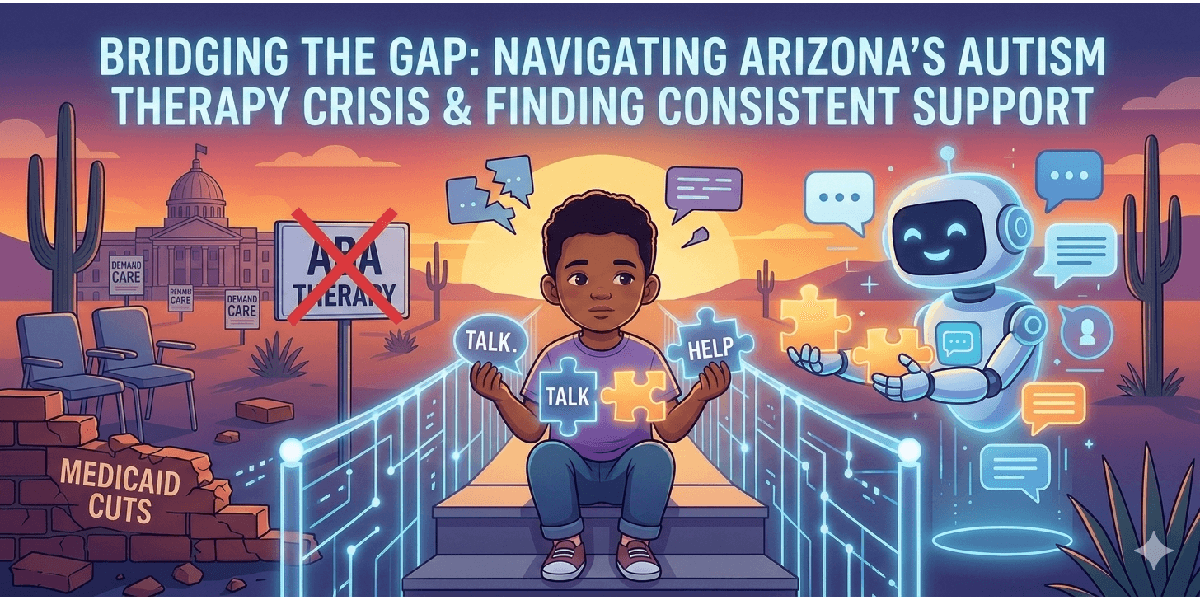
If you're an Arizona parent of an autistic child, you may have received a letter this week that felt like the floor falling out from under you.
Nearly 1,000 children diagnosed with autism in Arizona are losing access to applied behavior analysis (ABA) therapy after Mercy Care, United Health, and Arizona Complete Health announced they are ending contracts with Action Behavior Centers and Centria Health — two of the largest ABA providers in the state. Families who relied on those providers are now being told to find new in-network providers or pay out of pocket.
Dozens of families gathered outside the state Capitol to demand that AHCCCS, Arizona's Medicaid program, preserve their children's access to care. One parent held a sign and addressed officials directly: "This is the face of the dreams you will crush. Do the right thing."
We hear you. And we want to help.
What Just Happened — And Why
This isn't a random corporate decision. It's part of a wave that's been building across the country.
States including North Carolina, Nebraska, Idaho, Indiana, and Colorado have all recently cut or attempted to cut Medicaid payments to ABA providers as spending on autism therapy has ballooned. The federal Office of the Inspector General has been investigating ABA billing practices across multiple states. In Colorado alone, auditors found $77.8 million in improper Medicaid payments for autism therapy and ordered a $42.6 million federal repayment, triggering emergency reviews that are now spreading nationwide.
The result is a system under enormous financial pressure, and the families caught in the middle are bearing the cost.
For the children losing care this week — many of whom are nonspeaking or minimally speaking — a sudden gap in therapy isn't just an inconvenience. It's a disruption to the consistency and repetition their brains depend on to build communication skills.
The Gap That Was Already There
Here's something that often gets lost in these conversations:
Even before this week's cuts, the average autistic child receiving ABA or speech therapy was only in a clinical setting for a fraction of their waking hours. A typical speech therapy session runs 30 to 60 minutes, once or twice a week. That's less than 1% of the week. Everything else — the language practice, the communication attempts, the generalization of skills — falls to families at home.
For most families, there's no bridge across that gap. No tool. No patient, consistent practice partner that's available at 7 PM when your child is suddenly trying to communicate something and you're not sure how to respond.
That's the problem KidsChatGPT was built to solve.
What KidsChatGPT Is — And What It Isn't
Let's be direct: KidsChatGPT is not a replacement for ABA therapy or speech therapy. What happened in Arizona this week is a crisis, and families deserve real clinical care restored as quickly as possible.
What KidsChatGPT is, is the tool that helps during the in-between. The hours when no therapist is present. The long stretch between now and whenever coverage is restored or a new provider is found.
KidsChatGPT is an AI communication platform purpose-built for children with autism and communication challenges — shaped by the SLPs and therapists who discovered it and started recommending it to families. Here's what it does:
For children: A patient, low-pressure communication partner they can type to, talk to, or interact with on their own terms. No judgment when words don't come out right. No frustration. No time limits. Available whenever your child is ready — which, as every autism parent knows, is often not on anyone else's schedule.
For families: A safe, encrypted environment designed for children, not a general-purpose chatbot. Voice support for natural interaction. Conversation tracking so you can see patterns over time. And at $7/month, it's designed to be accessible to families in exactly the kind of financial stress this week is creating.
For the SLPs and therapists still working with your child (if you're fortunate enough to have that): A professional tier at $79/month that includes a therapist dashboard, AI-generated session summaries, patient progress tracking, and a home practice tool you can recommend with confidence.
If You're in Arizona Right Now
Here's what we recommend families do immediately:
Contact AHCCCS. Arizona's Medicaid agency is under pressure from families and advocates. Document your child's situation and add your voice. The Capitol rally this week showed families are organizing — that matters.
Ask your current provider about transition planning. Before coverage officially ends, get session notes, progress summaries, and copies of your child's goals in writing. This will be critical when you find a new provider.
Search for in-network alternatives now. The AHCCCS provider directory is searchable at azahcccs.gov. Waitlists will fill fast. Get on them today, not next week.
Don't let the at-home practice stop. Consistency is everything for autistic children building communication skills. While you navigate the insurance chaos, keep the home environment as structured and language-rich as possible. KidsChatGPT can help fill that role — it's available now, no waitlist, no prior authorization required.
The Bigger Picture
Arizona isn't an isolated case. Across the country, Medicaid spending on autism therapy has surged dramatically — North Carolina's payments are projected to increase 423% from 2022 to 2026, and Indiana saw a 2,800% rise in recent years. The system is straining everywhere.
Meanwhile, the CDC reports autism now affects 1 in 31 children — a 400% increase since 2000. More children need services. Fewer are getting them. Waitlists in some parts of the country stretch to 42 months.
The families bearing this load are doing so without adequate support, without sufficient tools, and often without even knowing what options exist.
KidsChatGPT exists because this gap is real. Because the 99% of the week when a therapist isn't in the room still matters. Because autistic children deserve consistency, patience, and a judgment-free space to practice communication — even when the insurance system fails them.
You Didn't Cause This. But You Can Navigate It.
To every Arizona family affected this week: what you're feeling is valid. The anger is valid. The fear is valid. The exhaustion of fighting a system that keeps moving the goalposts — that's valid too.
You didn't cause this crisis. But you know your child, and you know how to fight for them. You've been doing it since the day they were diagnosed.
We're here to help with what we can. If KidsChatGPT can bridge even a few of those lost therapy hours — if it can be the patient, always-available practice partner your child needs while you sort out the insurance nightmare — then we want you to have it.